

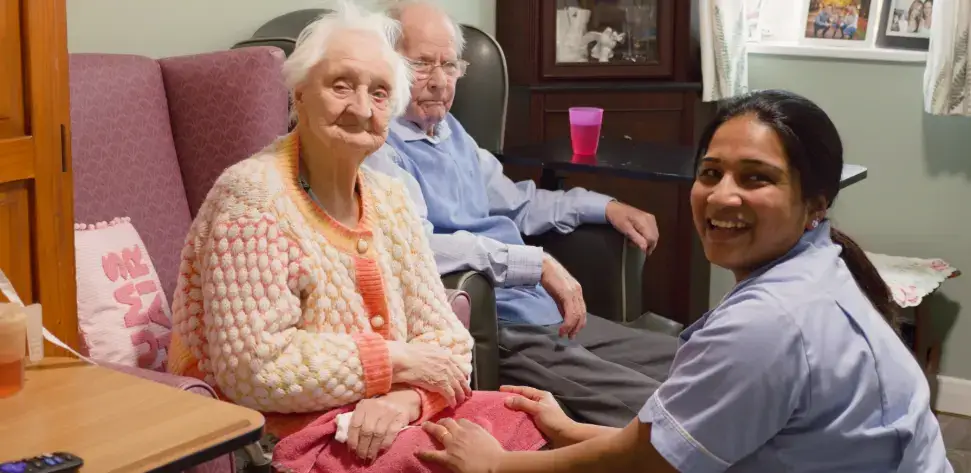
Dementia care is specialist residential support designed for people living with Alzheimer's disease, vascular dementia, Lewy body dementia, and other forms of cognitive decline. It goes beyond standard care because the people it serves have needs that change day to day, sometimes hour to hour, and the environment, routine, and team around them have to be capable of meeting that.
At Pearl Healthcare, we have been providing dementia care across Lincolnshire and the Isle of Man for over 20 years. Our teams at Kimberley Care Village in Spalding, Capricorn Cottage, and Sunnydale understand what this condition takes from a person and from their family. We see it every day, and we have built our approach around that reality.
Why is dementia care different from standard residential care?
Residential care provides support for daily living: meals, personal care, companionship, medication management. Dementia care includes all of that, but layers on specialist knowledge and a different kind of attention.
Someone living with dementia may not be able to communicate distress clearly. They may become anxious in unfamiliar environments, resist care, or experience behaviour that looks challenging but is actually an expression of unmet need. Managing those moments well requires training, patience, and genuine understanding of what the condition does to a person's perception of the world.
"We see the person, not the disease. Their life story matters. Their preferences matter. Their feelings matter." -- Pearl Healthcare
Our staff are trained to look past the behaviour and understand what is causing it. Someone who wanders may be looking for something familiar. Someone who refuses a meal may simply not recognise what is on the plate. We respond to the cause, not the symptom.
What does dementia care actually include?
A good dementia care service covers a lot of ground. At our homes across Lincolnshire and the Isle of Man, care is built around the individual and reviewed regularly as their needs change.
Structured daily routines
Predictability reduces anxiety. Regular mealtimes, familiar faces, consistent routines throughout the day help a person with dementia feel safe rather than disorientated. We do not rigidly impose a schedule, but we do build rhythm into each day.
Meaningful activities
We do not keep residents busy for the sake of it. We focus on activities that connect: music from their era, reminiscence sessions using photographs and familiar objects, gentle gardening, crafts. These are not filler activities. They are moments of real connection.
Personal care delivered with dignity
Some residents need full support with washing, dressing, and moving around. Others just need prompts and reassurance. We adapt to where someone is today, not where they were last week.
Medication management
Prescribed medicines are administered safely and on time, with careful monitoring for any changes or side effects. This is especially important in dementia care, where medication can significantly affect behaviour and comfort.
Safe, familiar environments
Our homes are designed to reduce confusion without feeling clinical. Clear signage, secure gardens where residents can walk freely, quiet spaces, and communal areas that feel like home rather than a waiting room. Residents personalise their own rooms with photos, ornaments, and familiar furniture.
24-hour specialist support
There is always someone available, day and night, with the training to respond appropriately. Managing a person's distress at 2am requires a different set of skills to standard care, and our teams have them.
Who is dementia care for?
Dementia care is for people whose cognitive decline has reached a point where they can no longer live safely at home, or where the burden on family carers has become unsustainable. That threshold is different for every family.
Some people come to us in the earlier stages, when they still have a great deal of independence but need the reassurance of a structured, safe environment. Others move in at a more advanced stage, when full personal care and specialist behavioural support are needed.
If you are caring for a family member at home and finding it increasingly difficult, it is worth having a conversation sooner rather than later. We can help you understand what level of support is appropriate and what your options are.
The three stages of dementia and how care changes
Dementia progresses differently in every person, but broadly moves through three stages. Understanding where your loved one is helps you understand what kind of support they need.
Early-stage dementia
Memory lapses, confusion in unfamiliar situations, and some difficulty with daily tasks. Many people at this stage remain quite independent. Our focus is on maintaining skills and confidence, supporting independence rather than replacing it.
Mid-stage dementia
Confusion becomes more frequent. Personal care, medication, and meals increasingly need support. Anxiety may increase, and some behavioural changes may emerge. We provide structure and consistent reassurance, and activities are adapted to current abilities.
Advanced dementia
Full personal care is required. Communication becomes very limited. We focus on comfort, dignity, and the small moments of connection that still matter: a hand held, a familiar song, a gentle voice. Our palliative care capability is closely integrated at this stage for those approaching end of life, and you can read more about that in our guide to palliative care at Pearl Healthcare.
What does the move into dementia care look like?
The transition into a dementia care home is one of the most difficult decisions a family can face. There is often guilt involved. Families worry they are giving up, or that their loved one will feel abandoned. We hear this every time.
Moving someone with dementia into the right environment is not giving up. It is recognising that their needs have outgrown what one person, however devoted, can safely provide.
We make the transition as gradual as it needs to be:
- Pre-admission visits to meet the team, see the home, and have lunch together
- Encouragement to bring personal items that make the room feel familiar
- A settling-in period that follows the resident's pace, not ours
- Open visiting for family, with no rigid hours
Many families tell us the first few weeks are harder for them than for their loved one. The familiar faces, structured routine, and calm environment often settle someone with dementia more quickly than expected.
How does dementia care interact with family?
Families remain central. We are not taking over. We are sharing the weight.
We will update you on how your loved one is doing, flag any changes in health or behaviour, and always involve you in significant decisions. If something is worrying you, call us. If you want to understand what a new behaviour means, ask. Our teams are experienced at explaining what is happening in plain language.
We also understand what it means to watch someone you love change. The grief of dementia is disenfranchised grief, mourning a loss that is happening slowly while the person is still there. Our staff do not just care for residents. They support families too.
How much does dementia care cost?
Dementia care typically costs more than standard residential care because of the specialist staffing and environment it requires. Costs vary depending on the level of support needed and which of our homes you choose.
There are several routes to funding:
- NHS Continuing Healthcare (CHC): Available to those whose primary needs are health-related. We can help you apply and navigate the assessment process.
- Local authority funding: For those who do not meet the asset threshold for self-funding.
- Self-funding: We accept self-funding residents and are always transparent about fees from the first conversation.
When you contact us, we will give you a clear picture of costs with no jargon and no hidden charges.
Dementia care at Pearl Healthcare
Our dementia care homes are in Lincolnshire and the Isle of Man. Kimberley Care Village includes a dedicated high-dependency unit for residents with advanced dementia, and our teams across all locations are trained and experienced in supporting people at every stage of the condition.
If you are trying to work out whether dementia care is the right step for your family, we are happy to talk it through. You can arrange a visit to any of our homes with no obligation. Come and see the environment, meet the team, and ask whatever questions are on your mind.
Get in touch with the Pearl Healthcare team or call us to arrange a visit.